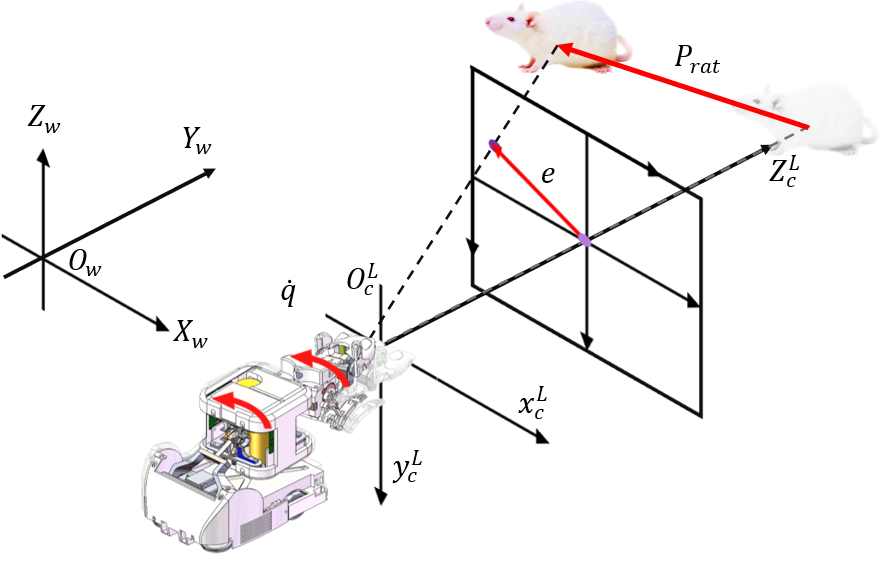
Robotic rats with bio-mimetic morphology and controllable movement patterns can replace real animals in behavioral interaction experiments and thus, have important research value in the biomedical field. Real-time generation of rat-like motions during interaction and stable and fast tracking of animals are necessary for autonomous behavioral interaction experiments. The current robots used for animal behavioral interaction experiments suffer from spatial inconsistency in motion data representation, low bio-mimetic similarity in motion expression, and poor motion control tracking ability. In this work, we propose a data-driven motion planning method for the behavioral interaction of the bionic robot mouse SMuRo, and realize real-time tracking of the laboratory rat and bio-mimetic motion generation for the robotic rat during the interaction.
In order for the robotic-rat to produce rat-like motions, lab rat motion data is gathered and classified into multiple behavioral patterns forming a lab rat motion dataset. Markers are placed on the rat's spine to capture the spine contour curve of the rat. The position of the markers was chosen based on Key Movement Joint (KMJ) analysis previously done by our team.
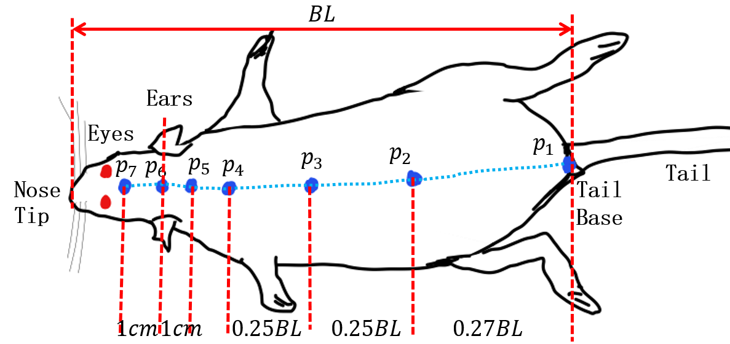
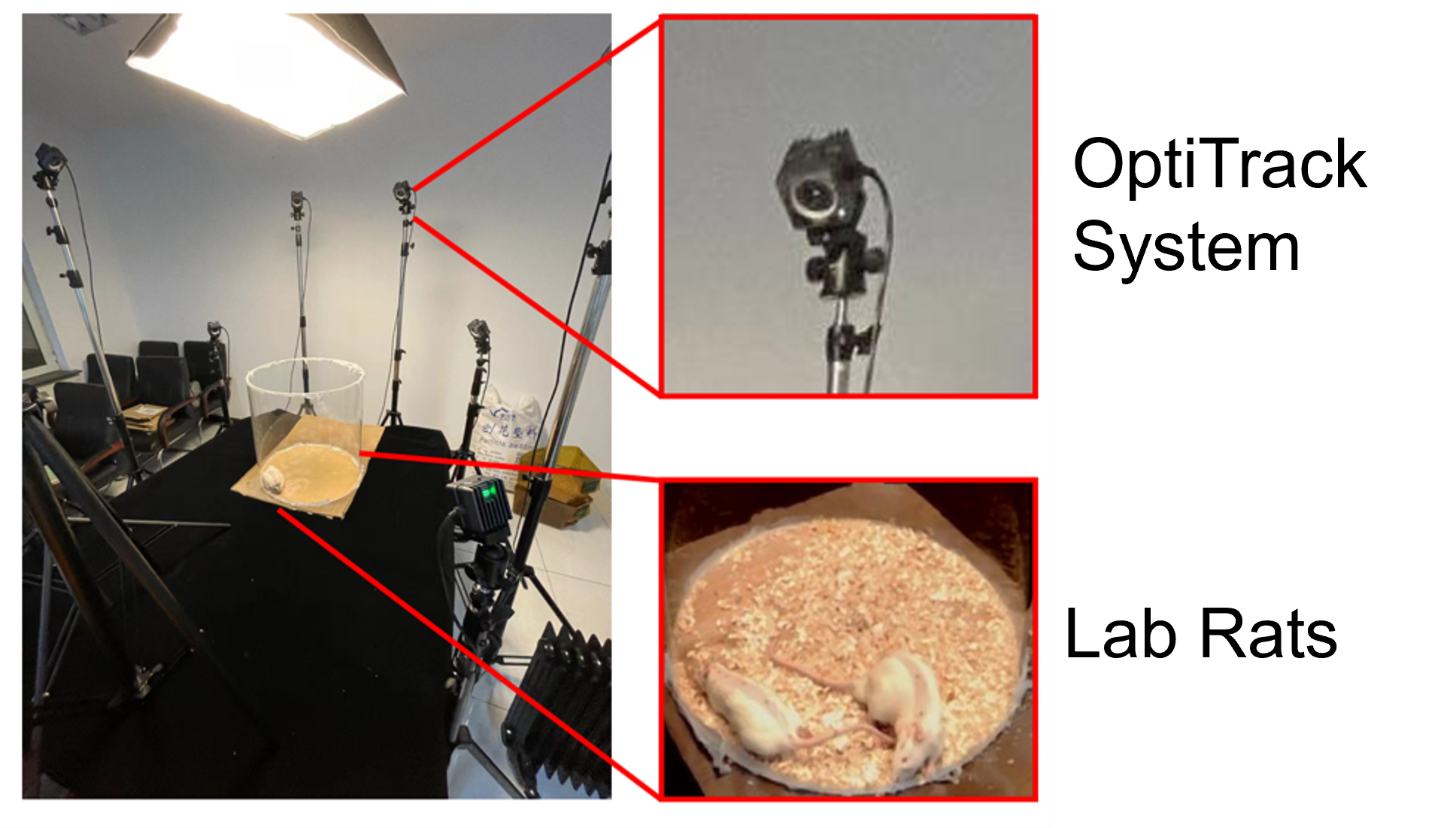
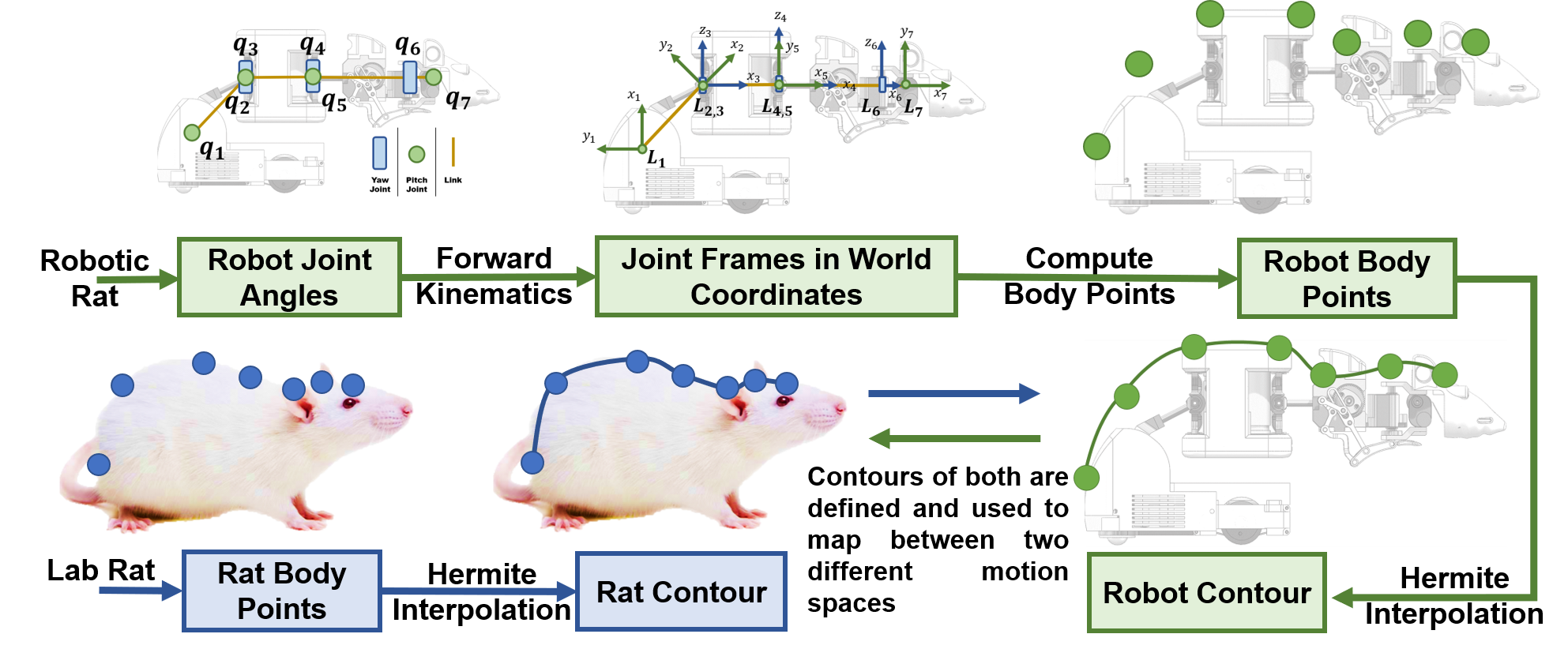
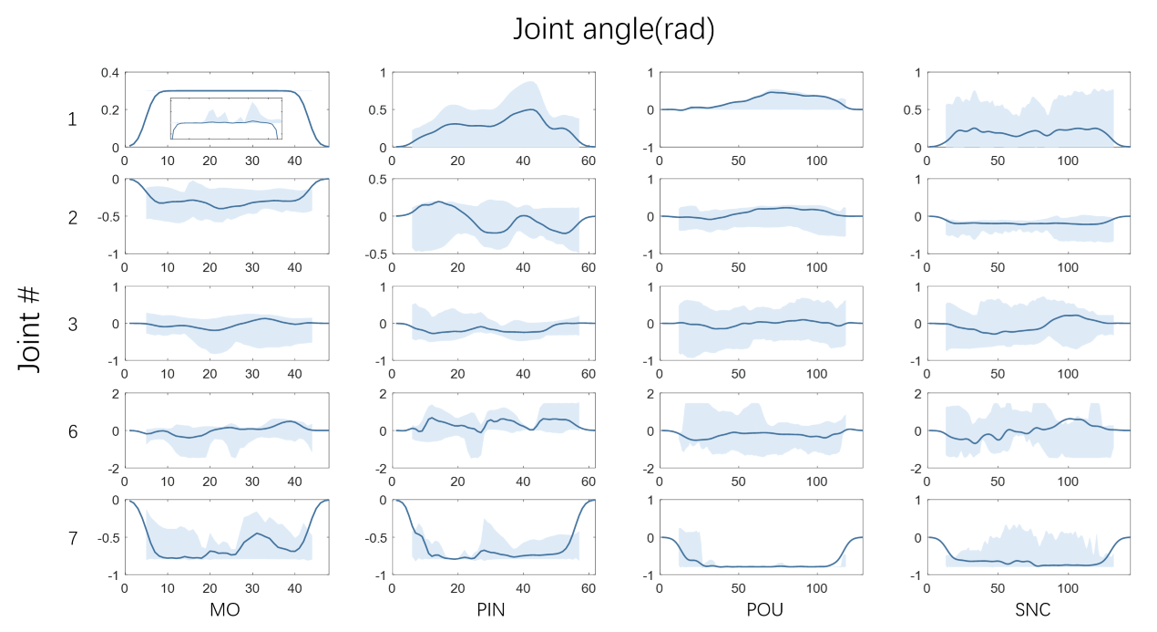
Due to difference in motion space between the motion data and the joint space of the robotic rat, a mapping relationship between them needs to be established. We propose a mapping method that finds the joint angles of the robotic rat that correspond to a certain spine configuration by minimizing the Euclidean distance between the spine contour curves of both rats. Thus, the mapping problem is formualted as a nonlinear curve fitting optimization problem, and is used to convert the rat motion data to the robotic rat joint space under different behavioral patterns. The resulting is evaluated using cosine similarity, which showed a minimum of 96% similarity between both contours
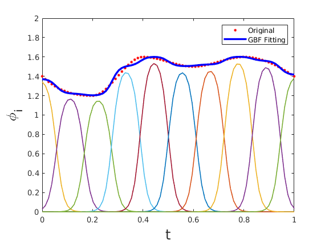
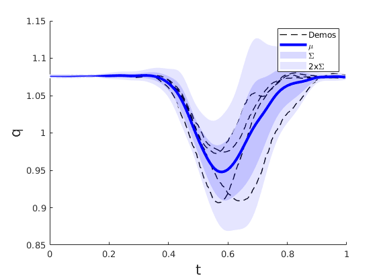
Probabilistic Motion Primitives are used to model the motions of each behavioral pattern from the mapped dataset. The randomness of Gaussian models allows us to construct a probabilistic model with a distribution consistent with that of the laboratory rat motion data in order to generate motion trajectories in the joint space of the robotic rat that follow the same patterns.
A rat tracking algorithm using Image-Based Visual Servoing (IBVS) is proposed. By deriving the interaction matrix and the robot jacobian, a Task Jacobian is constructed to model the mapping relation between the tracking error in pixel coordinates and the joint angles in joint space of the robotic rat. The algorithm achieves fast and stable real-time target tracking and outperforms a previously used rule-based algorithm.Finally mock behavioral interaction experiments are conducted to verify the validity of the proposed methods.